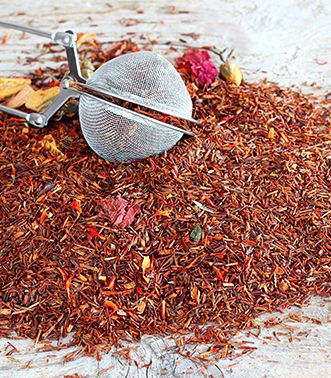
Red tea, or rooibos, is an herbal infusion with roots in South Africa. Long enjoyed by indigenous communities for its medicinal properties, it has won over European palates in recent years. Its nutty flavour and wealth of health benefits make it as appealing to the taste buds as it is to the body.
The name "rooibos" comes from the dialect of South Africa's early settlers and means "red bush". Today a true national drink in South Africa, rooibos contains no caffeine, which means it can be enjoyed at any time of day without any compromise on its many health-giving properties. It is called "red tea" because of the deep red colour it develops during production, but it does not actually belong to the tea family. Rooibos is better understood as an herbal infusion.
Rooibos: an herbal infusion from a shrub native to South Africa
Rooibos originates from a mountainous region some 200 kilometres from Cape Town, South Africa. It does not come from the tea plant (Camellia sinensis) but from a broom-family shrub known as Aspalathus linearis. Rooibos is therefore not strictly a tea — it is closer to an herbal infusion, containing neither caffeine nor theine.
This is a genuine advantage: rooibos can be enjoyed at any hour of the day. In the evening, you can sip red rooibos without worrying about sleep disruption, which can sometimes be a concern with caffeinated drinks.
Red rooibos is grown mainly in South Africa, on high-altitude plantations, where it has been consumed for centuries. It has since travelled across the world and become a much-loved drink for its remarkable properties. Like tea, rooibos is a genuine wellness ally.
How to prepare rooibos: the traditional South African way
Rooibos has a gentle, nutty sweetness and makes for a wonderfully flavourful infusion. Traditionally, it is served with milk and a touch of sugar, much like a classic English tea. This South African brew is winning more and more fans across Europe, where enthusiasts enjoy it plain or explore its blends fragrant with spices, flowers or citrus.
Preparing rooibos is much like preparing tea: simply steep the leaves in hot water using a filter or tea infuser. To get the most from rooibos's unique aromas, it is worth following the recommended brewing time and water temperature indicated on the packaging, as these can vary between blends. Rooibos has a naturally sweet, smooth flavour, so there is no need to add sugar — and it is completely calorie-free. It can be enjoyed hot or as an iced rooibos infusion.
Where does rooibos red tea come from?
Rooibos comes from a shrub species native to South Africa. It has long been consumed by indigenous communities for its many medicinal properties.
The plant behind rooibos is Aspalathus linearis. Its leaves are harvested at the start of the year and then oxidised before being dried in the sun: this is where they take on rooibos's characteristic hue. Plain rooibos is packaged as is, while many blends pair it with other flavours — often fruity — to create unique and original tastes: vanilla rooibos, organic orange and lemon rooibos, and more. There is always something new to try depending on your mood.
Rooibos, red tea, rooibos infusion: what is the difference?
Rooibos is also known as red tea, though this is not strictly accurate since it is not a tea. A more precise term would be rooibos infusion, as it contains neither caffeine nor tannins.
You will often hear several terms used interchangeably: rooibos, red tea, herbal infusion. Is there actually a difference? Not really. The main thing to remember is that calling it "tea" is a slight misnomer, since it contains no theine. You can comfortably refer to it as a rooibos infusion or herbal infusion. It is also worth noting that rooibos is not always red: other varieties exist. Green rooibos, for example, is an unfermented version that is growing in popularity for its remarkable properties. In that case, of course, the term "red tea" no longer applies.
How rooibos is fermented
Like tea, rooibos leaves are harvested and dried before consumption. Once dried, they take on a distinctive needle-like shape and a rich garnet colour.
There are different production methods. Red rooibos, the most familiar variety, is made by adding water to the leaves, which then oxidise over a process lasting anywhere from 8 to 24 hours. In other cases, there is no fermentation, and the result is green rooibos: this variety dries directly in the sun, with no added water, allowing the leaves to retain all of their beneficial properties. Rooibos is sold in small leaf pieces, often as loose-leaf rooibos, which can be blended with other flavours to create distinctive combinations.
Why choose organic rooibos?
Organic rooibos is a red tea grown using organic farming practices, meaning it has not been treated with harmful pesticides. Only certified organic teas and herbal infusions guarantee a high standard of quality and safe, worry-free enjoyment.
But why does it really matter to choose organic rooibos? You might be surprised by what can end up in your cup when you opt for a non-organic variety. Tea leaves are not washed before brewing, which means that when they carry pesticide and chemical residues, those go straight into your drink. This makes the case for organic rooibos herbal infusion clear: no aggressive treatments, a cleaner taste, and a gentler impact on your health. The flavour of organic rooibos is also noticeably better. Why settle for less?