Origin of Green Tea: History & Legends

Green tea is enjoyed around the world for its distinctive flavour and its many benefits. Rooted in the heart of Asia, it has spread across the globe to become a cherished ritual in countless cultures. But where does this beloved drink actually come from, whether sipped hot or cold?
For a traditional green tea with an approachable flavour, our organic loose-leaf Bancha beautifully bridges Chinese tea culture and Japanese inspiration.
Looking for a drink that blends Chinese tradition with the freshness of botanicals? Our organic peppermint green tea pairs Gunpowder with peppermint for an infusion that is both invigorating and easy on the digestion.
Chinese green tea: centuries of history
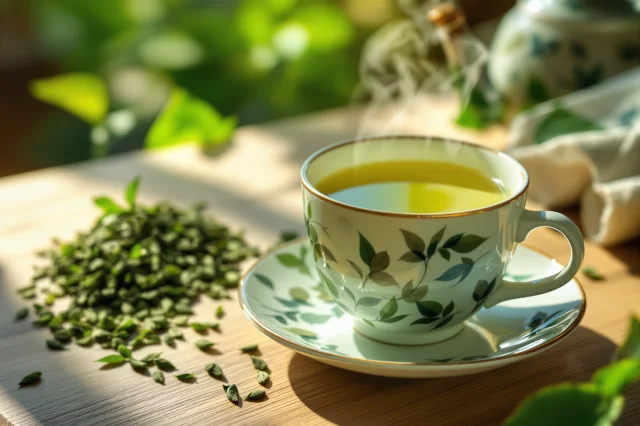
Green tea is the earliest variety of tea ever produced. There are many legends surrounding its origins, but the most famous traces it back nearly 5,000 years. Around 2700 BC, Emperor Shennong, a great botanist and the father of traditional Chinese medicine, is said to have been the first to discover this remarkable drink. While resting beneath a wild tea tree, a leaf fell into his cup, creating a new brew entirely by chance. Struck by its aroma and its restorative properties, he began incorporating tea into many of his remedies. Over time, green tea became a luxury and a true tradition, gradually crossing the borders of China and spreading throughout Asia and beyond.
How to prepare Chinese green tea
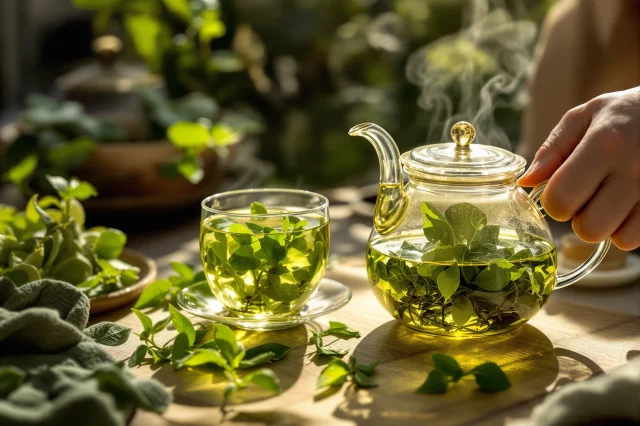
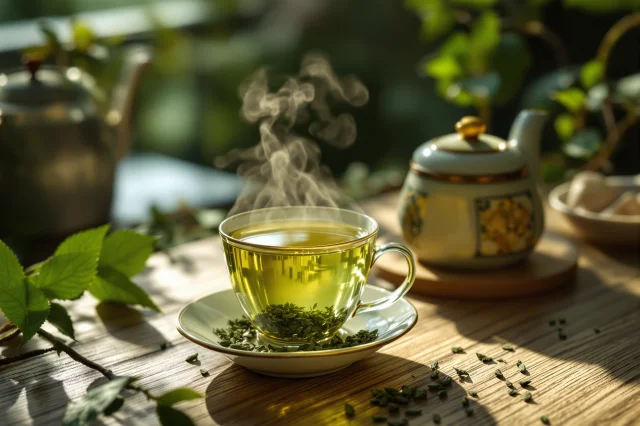
The Chinese method traditionally calls for a cast iron teapot. Water temperature and steeping time are key factors and should be followed carefully to bring out the best in your tea. These parameters vary depending on the variety. For example, Chinese Chun Mee green tea, with its smooth flavour and gentle hint of bitterness, is steeped for 2 to 3 minutes in water at 75 to 80°C. To reduce bitterness, a first 30-second infusion is recommended, with the water then discarded. Chinese Gunpowder green tea, the base of the classic mint tea, typically steeps a little longer, around 3 to 4 minutes, at 80°C. Purists enjoy it plain, but it is equally delightful with a touch of sugar.
Japanese green tea: another legend
Japan is home to a remarkable diversity of tea varieties. Enjoyed for over 1,500 years, Matcha is the most beloved of all Japanese teas. It is in fact a very fine powder, made by stone-grinding green tea leaves. Legend has it that tea was brought to Japan by an Indian Buddhist monk. At the time, it was traditionally prepared by boiling it in milk with salt and spices. It was in 1191 that Matcha arrived in Japan and quickly became an extraordinarily popular drink. The tea ceremony remains one of the most deeply rooted rituals in Japanese culture.
How to prepare Japanese green tea
Japanese tea comes in a wide array of varieties, each with its own preparation specifics. Among the most widely consumed is Japanese Sencha, which accounts for 80% of all tea produced in Japan. Known for its golden-yellow colour, it offers a delicate aroma and a flavour that is both gently bitter and smooth. Japanese Bancha also ranks high and is notable for its high iron content. Both teas are prepared the same way: steeped for 2 minutes in water at 70°C.
Explore our range of organic green teas: Japanese Sencha, Gyokuro, Matcha, Bancha, Chinese Gunpowder, Long Jing and flavoured blends (jasmine, mint, fruit). Certified organic farming, delivery across France.