Pu-erh or Red Tea? Differences with African Rooibos

Pu-erh represents one of China's most significant tea traditions. Originating from Yunnan, it has won over tea lovers the world over with its distinctive earthy, woody character. Shaped into cakes or tuocha, Yunnan tea comes in both black and green varieties. Its journey from ancient tea trees to the teapot is a storied one, and this infusion is also valued for its benefits on cholesterol levels. A deep dive into China's Yunnan region, to tell you everything you need to know about Pu-erh.
What colours does Yunnan tea come in?
Pu-erh, often referred to as China's dark tea, is available as either a green tea or a black tea.
Green Pu-erh: a traditional cake
Green Pu-erh is Chinese in origin. This drink has been enjoyed in Yunnan since the 17th century, though some ancient wild trees suggest an even older heritage, stretching back over 1,000 years. The way green Pu-erh is made has changed little through the ages. It is still compressed into cakes without any fermentation. For purists, this is the only true Pu-erh.
Opinions on green Pu-erh vary. Some find it too bitter, with an earthy, damp-soil quality. Others appreciate its gentle, delicate notes. These differences in flavour often come down to the trees themselves and the leaves that are picked. Yet this small pressed tea cake remains the traditional drink of China's Yunnan region.
Black Pu-erh: a post-fermented tea made for export
Black Pu-erh is a more modern Chinese production. The tea leaves are oxidised, changing both in colour and flavour, before being compressed into cakes or bricks. Producers make it primarily for export.
Pu-erh processed this way develops richer, more complex aromatic notes. Deep brown in colour, these teas undergo a gentle fermentation. This is an "aged" tea, often matured over several years. Compressed into cakes from wild-harvested leaves, it keeps exceptionally well over time. The flavour that emerges is woody and subtly sweet.
These Chinese dark teas contain less caffeine than coffee. They come from wild tea trees, which contribute to their reputed benefits for cholesterol. They are, in every sense, a wellness drink, appreciated across Europe and throughout Asia.
Pu-erh: black tea or red tea?
The question of what colour to call Pu-erh, the famous Chinese tea from Yunnan, has long been debated. Some producers even use the terms incorrectly on their own labels. Sold loose-leaf or in pressed cakes, it is a true Chinese black tea, made from the leaves of the tea plant.
Both in China and in Europe, Pu-erh is classified as a black tea, because it is post-fermented. This places it in the same broad family as Oolong, another prized infusion whose price reflects its prestige. Other black teas are called red teas in China, because their production involves no post-fermentation stage.
What is the Western "red tea"?
In Europe, a red infusion is not tea at all. It refers to rooibos, an organic plant native to South Africa that bears no relation to the tea plant. The true tea plant is Camellia sinensis, although Pu-erh also comes from Camellia taliensis.
That said, even though it is something entirely different, rooibos is excellent for health, particularly for cholesterol. It can even be blended with teas to create original and distinctive aromatic profiles.
In brief. In China, Pu-erh is classified as a dark tea (post-fermented). In the West, it is sometimes mistakenly called "red tea" because of the colour of its liquor. But the true Western "red tea" is rooibos, a South African plant that is not tea at all. Three drinks, three plants: here is how to tell them apart.
Pu-erh, Chinese red tea, and rooibos: a comparison
| Criteria | Pu-erh | Chinese "red tea" (hong cha) | African Rooibos |
|---|---|---|---|
| Plant | Camellia sinensis (tea plant) | Camellia sinensis (tea plant) | Aspalathus linearis (legume) |
| Origin | Yunnan (China) | Fujian, Yunnan, Anhui (China) | Cederberg (South Africa) |
| Processing | Extended post-fermentation (months or years) | Full oxidation | Oxidation of the needles |
| Caffeine | Moderate (~40 mg/cup) | Higher (~50 mg/cup) | None (caffeine-free) |
| Liquor colour | Copper-brown, almost black | Amber red | Orange-red |
| Flavour profile | Woody, earthy, smooth | Malty, honeyed, fruity | Naturally sweet, vanilla-like |
Why is Pu-erh sometimes called red tea?
The confusion comes from a linguistic mismatch. In Chinese, what the French call "black tea" translates as hong cha, literally "red tea", a reference to the colour of the oxidised liquor. Pu-erh, however, belongs to a distinct category: post-fermented dark teas (heicha in Mandarin). Western traders, often uncertain how to classify Pu-erh, sometimes placed it under the "red tea" label, adding to the confusion.
Under international terminology (ISO standard 3720), plain Pu-erh remains a dark tea, distinct from black teas such as Earl Grey or Darjeeling second flush. Its production method, based on controlled microbial fermentation, makes it one of a kind.
And rooibos, the true Western "red tea"?
Rooibos (pronounced "roy-boss") is not tea, as it does not come from the Camellia sinensis plant. This plant, endemic to South Africa, belongs to the Fabaceae family (legumes). Known as "red tea" in French simply for the colour of its infusion, it is naturally caffeine-free, making it a popular choice in the evening and for children.
Its characteristics are radically different from Pu-erh: no caffeine, a naturally sweet flavour, and no microbial fermentation whatsoever. If you are looking for a true caffeine-free "red tea", our organic rooibos infusions are the place to start.
Your questions about Pu-erh, red tea, and rooibos
Does Pu-erh contain caffeine, like rooibos?
No: Pu-erh does contain caffeine (as all true teas do), around 40 mg per cup, while rooibos contains none at all. For a completely caffeine-free drink, rooibos is the answer.
Which is healthier, Pu-erh or rooibos?
They offer complementary benefits. Pu-erh is known to support digestion after rich meals. Rooibos is rich in specific antioxidants (aspalathin), contains no stimulants, and is ideal later in the day.
Can you mix Pu-erh and rooibos?
Purists would not recommend it, as the flavour profiles are very different. That said, there is nothing to stop you alternating between the two throughout the day, depending on what you need.
Explore our range of organic Pu-erh teas from Yunnan: raw sheng, ripe shou, cakes, bricks, and mini tuo cha. Direct sourcing, certified organic farming.
Tempted to try it?
Our selection related to this article, loose leaf and organic.
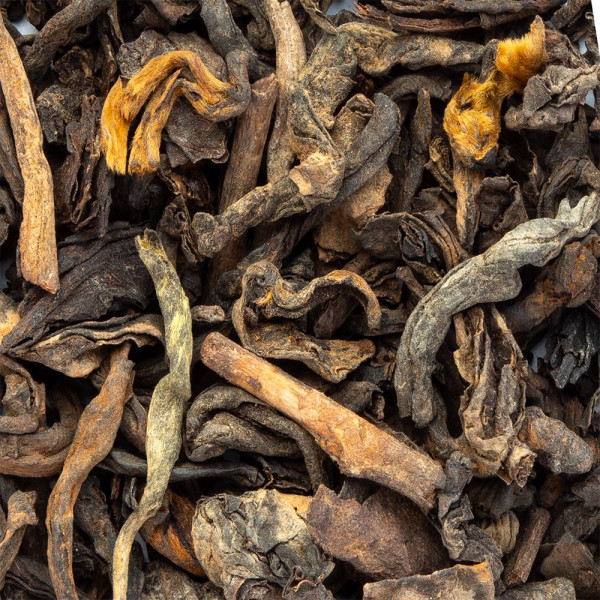
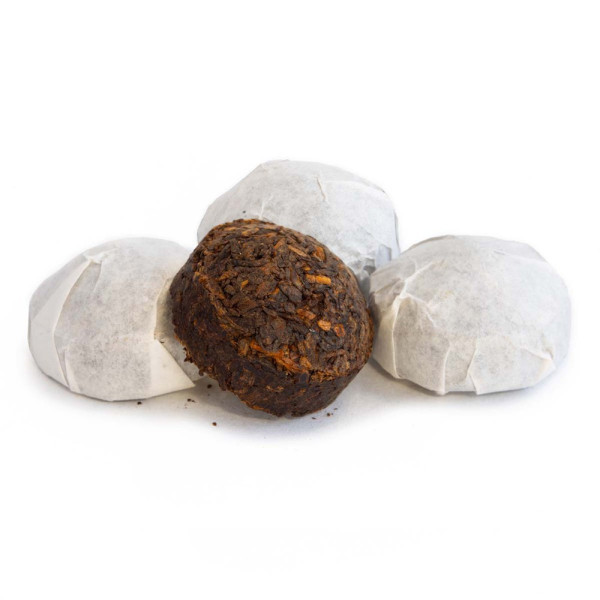
Pu-erh Mini Tuo Cha
The Pu-erh Mini Tuo Cha is a post-fermented tea from Yunnan, compressed into small individual nests of around 5 g each.
€6.00Discover
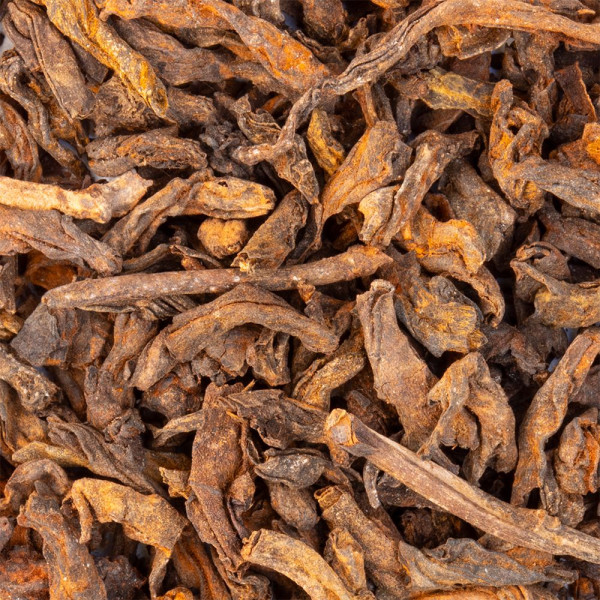
Pu Erh Menghai 5 Years
The Pu Erh Menghai 5 Years is a Chinese post-fermented grand cru, aged for five years to unveil its deep notes of dark chocolat…
€11.90Discover