Everything About Pu-erh Tea: A Complete Guide to Yunnan
Pu-erh represents China's most significant tea production. Originating from Yunnan, it has won over the world with its woody, earthy character. Pressed into cakes or tuocha, Yunnan tea can be either dark or green. Its journey from ancient tea trees to the teapot is epic, and this infusion has a wonderfully woody, earthy character all its own. A deep dive into China's Yunnan province, covering everything you need to know about Pu-erh.
In brief: Pu-erh is a post-fermented tea from Yunnan, China. It comes in two forms: raw Pu-erh (sheng), aged naturally over time, and ripe Pu-erh (shou), fermented through an accelerated process. Prized for its woody notes and recognised digestive benefits, it brews best at 90°C and welcomes multiple infusions.
What is Pu-erh, Yunnan's dark tea?
Enjoyed by the Chinese for over a thousand years, Yunnan tea has endured through the ages, offering its distinctive woody and camphor-tinged flavour. Celebrated, then banned, it ultimately became one of the most iconic productions of China's Yunnan region. To understand where it sits in the wider world of tea, you may also want to read our page on Pu-erh versus red tea. A delicate, luxurious drink, it stands as a true origin tea, a grand cru from southwest China.
Guide contents
Choose your starting point in the guide

Where does Chinese tea come from?
The origins of Yunnan tea are not entirely certain. In a distant era, tea leaves served as currency between Chinese and Tibetan merchants travelling what was known as the Ancient Tea Horse Road. The leaves were pressed into cakes, far easier to carry than loose-leaf tea. At that time, the only Yunnan tea in existence was green. Experts believe that climatic conditions caused the tea to undergo fermentation, turning the green cake dark and transforming its flavour entirely. The city of Pu'er, which gave the tea its name, was the epicentre of this trade during the 18th century.
How did Yunnan's dark tea survive China's dynasties?
Throughout history, Yunnan tea has known both great glory and dark times. Its earliest traces date to the Tang dynasty, when it was widely appreciated and produced in large quantities, becoming the emblematic drink of the region. Under the Ming dynasty, however, Yunnan tea nearly vanished: banned, it was made only clandestinely in remote corners of the province.
How did Yunnan tea become "Pu-erh Tea"?
The patience and perseverance of Yunnan's people eventually bore fruit. Under the Qing dynasty, dark tea enjoyed a remarkable revival, and compressed tea production flourished once more. The tea was renamed "Pu Ehr tea," or simply Pu-erh. Today, whether in a small porcelain teapot or a gaiwan, Yunnan tea remains widely enjoyed. An online shop like ours brings these grand crus within reach of tea lovers across Europe, with free delivery from €49.
How is Pu-erh, the dark tea, made?
Yunnan tea is crafted using a traditional method. Picked from wild tea trees, the leaves are processed before being pressed into the famous cake shapes. It is a making process built on expertise passed down through generations.
Where does Yunnan black tea come from?
Pu-erh tea grows on the mountain slopes of Yunnan. These wild trees, sometimes centuries old, yield leaves of exceptional quality. The Camellia sinensis var. assamica leaves are hand-picked loose when young but sufficiently developed. They are then pressed into cakes or tuocha, with or without post-fermentation. Yunnan's terroir, its volcanic soils and humid climate, creates ideal conditions for these ancient tea trees.
What is the journey from leaf to mao cha?
The tea trees dedicated to Pu-erh grow in small gardens on Yunnan's mountain flanks. Untouched by chemicals, the teas from this land are entirely organic. A number of local producers still follow a fully manual approach, ensuring the quality of the final product.
When are the leaves picked?
These tea trees are harvested twice a year. The spring harvest (March to May) is renowned for producing the finest teas, while the autumn harvest (September to November) also yields infusions of remarkable quality. Typically, each picking includes one tea leaf and a bud. For lovers of grand crus, the pre-Qingming spring pickings are particularly sought after.
How are the tea leaves processed?
After picking, the leaves are spread on mats. Following sun-withering, they are rolled to encourage post-fermentation, then set out to dry in the sun. At this stage, Yunnan tea is known as mao cha. It is green and ready to be either pressed into cakes or aged loose-leaf. For a dark Pu-erh, this is where post-fermentation begins, taking place in a warm, humid cellar.
How does mao cha become a Pu-erh cake?
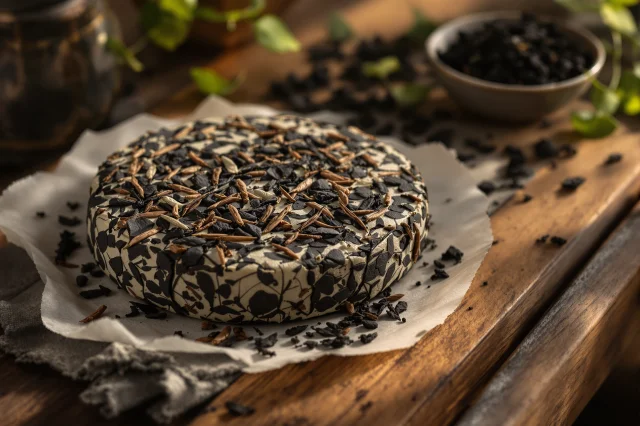
To make a traditional Pu-erh cake, the mao cha must weigh exactly 357 grams. The leaves are placed in a cylindrical container, then steamed to soften. The mao cha compacts. The tea leaves are poured into a cloth, shaped into a disc, and pressed. The cakes are then stored in drying rooms. Once dry, they are placed in bamboo baskets and begin their ageing. This fermentation stage gives them their characteristic flavour and colour.
What types of organic Pu-erh are there?
Depending on its fermentation method, Yunnan Chinese tea can be classified as raw or ripe. Purists call these Pu'erh sheng cha and Pu'erh shu cha. The two types offer very different aromatic profiles and brewing times.
What is raw Pu-erh?
Raw Pu-erh teas are also known as green Pu-erh teas. They are sometimes sold under the name Pu'erh sheng cha, or simply raw green sheng teas. Green Pu-erh is pressed into cakes or tuocha and then aged in a humid cellar. Its fermentation is slow and natural, sometimes spanning several decades.
What is ripe Pu-erh?
Ripe Pu-erh is a post-fermented tea, sold under the name Pu'erh shu cha. Unlike Pu'erh sheng cha, ripe Pu-erh undergoes an accelerated fermentation process: the tea is moistened with water, covered with a tarp, and left to ferment in a warm, humid room. This technique, known as wo dui, was developed in 1973 by producers in Menghai to meet growing demand.
Raw or ripe Pu-erh: how to choose?
To help you compare at a glance, here are the key differences between the two families of Yunnan teas we offer.
| Criterion | Raw Pu-erh (sheng) | Ripe Pu-erh (shou) |
|---|---|---|
| Fermentation | Slow, over several years | Accelerated, over a few weeks |
| Liquor colour | Amber to golden | Deep brown, almost black |
| Aromatic profile | Fresh, vegetal, slightly astringent when young, then woody with age | Earthy, woody, camphor-tinged, smooth and round |
| Ageing | Improves over the years | Ready to enjoy relatively quickly |
| Ideal for | Lovers of complex, evolving teas | Beginners and those who prefer smoother notes |
Whichever style you choose, store your cakes away from light and moisture. Our storage guide covers all the right habits for preserving the aromas.
How to recognise a quality Pu-erh?
Like Oolong, Yunnan tea is often imitated but never truly matched. Here are a few indicators to help you assess quality:
- Even when compressed, the tea should still contain whole leaves.
- The leaves should yield flavour across multiple infusions.
- While Pu-erh has no single fixed taste profile, its aromatic notes should not carry an unpleasant muddy aftertaste.
- The cake or tuocha should feel dense and firm.
- For vintage grand crus, check the origin and production year noted on the cake's paper wrapper.
Pu-erh and its terroirs: Menghai, Mengku, Lincang
Yunnan is home to several renowned production regions. Menghai, in southern Yunnan, is the birthplace of modern shou Pu-erh. Mengku, further west, produces mineral, complex sheng teas. Lincang offers Pu-erh with softer, fruitier notes. Each region carries its own terroir and character. The great historic factories (Menghai Tea Factory, Xiaguan Tea Factory) shaped the story of modern Pu-erh. Today, dozens of small producers craft their own unique blends, making Pu-erh tasting a particularly exciting pursuit.
How to brew a great Pu-erh?
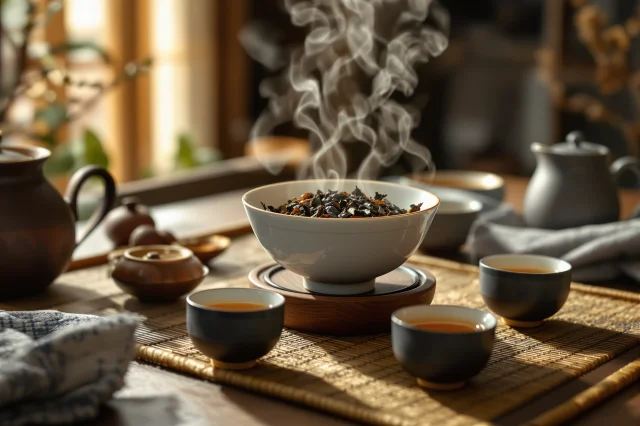
In China, preparing Pu-erh is almost a ritual. Traditionally brewed in a gaiwan, it is also enjoyed from a porcelain teapot or a Yixing clay pot. The experience engages every sense: visual (the copper-tinted liquor), olfactory (woody, earthy notes), gustative (a smooth roundness), and tactile (the warmth of the cup).
Yunnan tea comes in cake or tuocha form. You will need to break off the desired amount of leaves using a tea pick or similar tool. Brew in water heated to 90°C. The leaves unfurl and release their aromas, and can be used for several infusions. Chinese post-fermented tea is also available loose-leaf, at a more accessible price, without any compromise on character.
Gong fu cha preparation
For a traditional Pu-erh preparation, allow 5 to 7 g of leaves per 100 ml of hot water. Begin with a quick rinse (10 seconds at 95°C), then follow with short steeps (15 to 30 seconds), repeated 6 to 10 times. This method reveals every aromatic dimension of the tea. A dedicated Yixing teapot will further elevate the experience.
Western-style brewing
For a simpler approach: 4 to 5 g of leaves per 250 ml of water at 95°C, steeped for 3 to 5 minutes. Re-infuse 2 to 3 times. A quick, straightforward way to enjoy Pu-erh every day.
What are the benefits of organic Pu-erh?
The way a Pu-erh cake is made gives it a unique composition, which gives it its singular aromatic profile and draws the interest of researchers. No health claim is authorised for pu-erh, however: it is a pleasure drink, not a health product.
What does Chinese dark tea contain?
Young tea tree leaves are rich in polyphenols, which diminish during ageing as fermentation encourages the development of fungi. This post-fermentation phase, unique to pu-erh, is what shapes the infusion's woody character and distinctive aromas. Our dedicated guide on Pu-erh production methods goes into further technical detail. Pu-erh also contains theaflavins, thearubigins, and theabrownins, the latter being specific to fermented Pu-erh.
What makes organic Yunnan tea so distinctive?
As a Pu-erh cake ages, it slowly evolves under the action of micro-organisms that transform its aromas: this is what gives pu-erh its woody, earthy notes and rounded mouthfeel. No health claim is authorised for pu-erh, however, which remains a pleasure drink.
This fermented tea is also recognised for its digestive properties, which is why it is traditionally consumed after a hearty meal rather than at the classic "cup of tea" moment. If you are on long-term medication, it is advisable to consult a healthcare professional before regular consumption. As for weight loss, let us be clear: pu-erh is not a slimming tea. No study or regulation supports such an effect, and it is no substitute for a balanced diet or physical activity.
What are the traditional uses of the Pu-erh cake?
In the Canton region of China, Pu-erh is regarded as a medicinal drink. Sold as "Yunnan tea" or "tuocha," it has traditionally accompanied the end of meals in China. In the West, infusions from Yunnan's mountains are prized above all for their woody character and smoothness.
Pu-erh and the tasting experience
More and more tea blogs and in-store tasting workshops are introducing Pu-erh to curious palates. It is a unique experience in a small group: tasting several vintages, learning to identify regions, sharing notes. A tasting session centred on Pu-erh is one of the best ways to enter this complex world. Our in-store workshops allow us to present our selection from producing countries including China, Japan, India, and Ceylon, and to highlight the particular qualities of Chinese Pu-erh.
Buying Pu-erh online: practical advice
When purchasing Pu-erh online, several criteria matter. Choose a trusted online shop with transparent sourcing and certified organic products. An ideal Pu-erh collection includes at least one sheng, one shou, a vintage variety, and a convenient format such as mini tuo cha. Our shop offers a carefully curated selection of organic Pu-erh in loose-leaf, cake, and mini tuo cha formats, with free delivery from €49 within metropolitan France and secure payment.
What is the difference between Pu-erh and classic black tea?
Pu-erh is a post-fermented tea, while Western black tea is an oxidised tea. Pu-erh's post-fermentation involves micro-organisms that continue acting on the leaves after drying, giving it its earthy aromas and unique ageing potential. Black tea, by contrast, is fixed after oxidation.
How long can Pu-erh be stored?
A ripe Pu-erh (shou) is best enjoyed within 5 to 10 years of production. A raw Pu-erh (sheng), on the other hand, can develop and improve for several decades under the right storage conditions. This is what is known as vintage Pu-erh, whose value and aromatic complexity deepen with time.
Does Pu-erh contain caffeine?
Yes, like all teas derived from Camellia sinensis, Pu-erh contains caffeine, in quantities comparable to black tea (around 60 mg per cup). It is generally best enjoyed during the day and after meals, to support digestion, as Cantonese tradition recommends.
What does Pu-erh taste like?
Pu-erh has a truly distinctive flavour profile. Its primary notes include damp earth, forest floor, mushroom, leather, and precious wood. Shou teas often carry hints of cocoa and prune. Aged sheng teas tend toward dried fruit and beeswax. Rich and layered, Pu-erh is a natural choice for those who enjoy deep, complex flavours.
How to get started with Pu-erh?
To begin exploring Pu-erh, start with an approachable young shou (3 to 5 years old), ideally in mini tuo cha format for easy first brewing. Once you are comfortable with the earthy notes, move on to a young sheng for its more vegetal character, then progress to an aged sheng to experience what time does to the tea. This journey is one of the most rewarding a tea lover can take.
Explore our range of organic Pu-erh teas from Yunnan: raw sheng, ripe shou, cakes, bricks, and mini tuo cha. Direct sourcing, certified organic farming.
Tempted to try it?
Our selection related to this article, loose leaf and organic.
Pu-erh Mini Tuo Cha
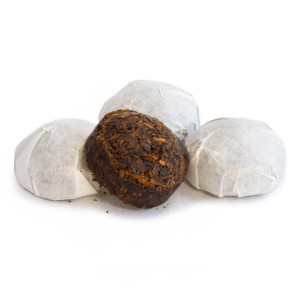
The Pu-erh Mini Tuo Cha is a post-fermented tea from Yunnan, compressed into small individual nests of around 5 g each.
€6.00Discover
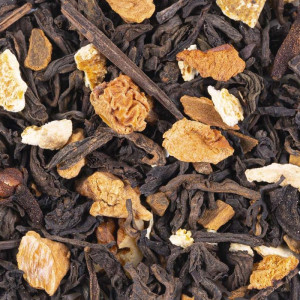
Pu Erh Cinnamon Orange
Organic Pu Erh Cinnamon Orange brings together the velvety depth of Chinese Pu-erh with warm notes of cinnamon and orange peel.
€10.90Discover